
thejuliemeister

Musings from an unsuspecting navy wife


Leave a comment

My First Marathon

When I set out to run my first marathon I had two goals:

  1. Finish.
  2. Do not poop yourself in the process.

I would have been satisfied with only the first goal.  I assumed a slight tinkle midway through was a foregone conclusion.  At least that I could pass off as sweat.

In the end I met both goals, (though at least one fart seemed it might have had questionable intentions) but it was the most grueling event of my life. 

The idea of training for a marathon came on slowly.  I signed up for my first half marathon on a lark a few years back as someone who could barely jog a 5K and walked most of the way.  Doubling that distance seemed a Herculean feat that only super-humans or the clinically insane could perform.

I slowly started running for realsies about 2 years after the first half marathon as a way to facilitate weight loss.  After 6 months of running with a goal and a training plan, I was able to run a half marathon and smash my previous personal record.  I also lost 40 pounds. 

An idea started to germinate.  Maybe I could be one of those criminally insane people and double the distance.  I ran 3 more half marathons and I was sold.  My husband, Cameron, and I were set to embark on our first military move as a couple from Monterey, CA to New England a week after my November running of the Big Sur Half Marathon.  Giddy off of that race, I signed up for a marathon in Rhode Island the following May. 

There is no way to understate what a terrible mistake that was.  I am a Californian, and up until that point, had never run out of state.  Monterey is ideal for runners.  There’s a great path along the ocean and the temperature is a perennial 65 Degrees.  I assumed training for my marathon from December through May would be just as easy as training for any of my other races. 

Then winter laughed in my face.  I recall trying to go out in a long-sleeved technical shirt, my “warm gear,” and nearly freezing to death.  I had to buy all new running clothes to fortify myself against the harshness of bitter, bitter cold.  My water froze once on a long run.  It was miserable.

Between cold weather and actual colds, I missed several training runs.  Cameron and our dog supported me through the longest runs by meeting me with water, energy gels, and face-licks every three miles.  Those support stops kept me motivated, but in the end my longest run pre-race was only 18 miles.  

The day of the race I was nervous.  I had trouble pooping before the start.  I told myself to walk as much as I needed to.  Time didn’t matter.  Poops didn’t matter.  Finishing was everything.  With that in mind, I made my way to the start area. 

My cousin, Jenna, had flown in from CA to run too.  She’s much faster and more experienced, so we didn’t plan to run in tandem.  But we lined up next to each other for the national anthem pre-race with all the other runners before the gun sounded the start.  Cameron was nearby just past the runner/spectator divider.  Jenna and I hugged after the anthem then she moved forward to a faster pace group.  Cameron smiled and gave me thumbs up for encouragement.  I just kept telling myself to walk as much as needed and I’d be ok.

The gun sounded and I was off.  Cameron promised to be there to check on me at miles 7 and 19.  I was glad to know there would be a friendly face in the crowd.

The first 7 miles were fairly easy.  I kept my pace slow and walked the water stops.  When I saw Cameron I gave him a kiss and high five then shuffled on.  I was doing it.  I could do it.

I started breaking down around mile 14.  I had walked a little before 14, but by this point I was walking several minutes at the start of each mile marker, then trudging along to the finish of that mile.  By mile 17 all I could think about was Cameron and the car at mile 19. 

“Just get to 19” I thought.  “Then you can quit.  Maybe fake an asthma attack.  Nobody would blame you then.”  I wasn’t thinking clearly anymore.  I couldn’t think at all really.  All of my energy was focused on getting to Cameron so I could go home.

A little past mile 19 I saw a bright pink “GO JULIE!” sign.  Cameron. Car.  Done.  I got to my husband, wrapped my sweaty arms around him and cried in agony. 

“It hurts!” I cried. 

“What hurts?”  He asked, clearly concerned. 

“Everything!” I responded.  I had hit the wall.  My whole body throbbed.  I thought my options were quitting or death. 

Cam put an arm around me to support a bit of weight and started walking me forward.  I tried to sit a few times in the road and he peeled me off the ground. 

He walked with me for over a mile.  Each step he made me repeat: “I can do it.”  I couldn’t, but I said it over and over.  Around mile 20 a small patch of fence arose to the right with no apparent purpose.  I sat on it and sobbed.  Cameron knelt before me and said the car was farther from me than the finish.  The finish was the only way forward.  It was a lie, but I believed.  I took an energy gel.  Cam helped me to stand.  I needed to run again.  We embraced then I slowly trudged off.

For the next 6.2 miles I jogged 5 minutes then walked 5.  It was slow going, but I hit my groove.  I was one of the last people to cross the line, but I finished, and Cameron was there with tears in his eyes.  Jenna had finished an hour before me.  We all hugged.


Image

“You did it!” Jenna exclaimed.  I didn’t do it.  We did it.  Cameron was as much to blame for my step over the finish line as I was.

I wish I could say the marathon was just a mental barrier I had to scale.  It wasn’t.  It was just as much, if not more physical than it was mental.  It took all of my strength, and some of Cameron’s to get me to the end.  But I crossed that finish and for over a week I kept the finisher medal in my purse as a reminder of just how much my body and mind can do. 

I’m not afraid of many things anymore.  Whenever I question my abilities to face something new I remind myself: “I’m a fucking marathoner!”  If I can do that, as long as Cameron is with me, I can do anything. 

1 Comment

In defense of the F-bomb

Warning:  Colorful language ahead

I love to swear.  Something about the sounds and meanings of certain words resonate so deeply with me I’m just giddy.  I love the taboo. I love the language.  In fact, I love all language.  I’ve found that to love the English language is to embrace all of its facets.  There is no such thing as a “bad” word, just words with meanings and sounds that not everyone likes. 

Fuck.  Ass. Shit. Balls. Bitch.

Why do these letter combinations incite such discomfort?  I was told at a young age that words can never hurt me, yet some of these words cause hurt feelings. 

Let’s look at how we garner meaning from mere syllables strung together.  Generally, word definitions are separated into two categories:  denotation and connotation.  Denotation is the literal definition.  The denotation of “ass” is a donkey.  The denotation of “bitch” is a female dog. 

Connotation is the feeling or idea that a word invokes that is secondary or additional to the literal definition.  The connotation for “ass” might be a jerk.  “Bitch” usually connotes an unpleasant or mean woman. 

A blend of denotation and connotation makes up the meaning of a word.  Sometimes obscenities provide the perfect blend for a given situation.  During a terrible bout of a tummy bug, I might shit my brains out.  While my brain has literally always seemed to remain intact, this turn of phrase seems the most accurate and appropriate.  Simply “pooping” or even “having diarrhea” just doesn’t describe the extreme havoc that exists in my digestive tract or the utter destruction of the toilet bowl.  In this case, using a profanity evokes the exact intended meaning while potentially adding a hint of levity. 

The idea that profanities might be just right is not new or constrained to pulp writers.  Many of the great names in literature have used profanities either to drive home a point, or for simple humor. Voltaire’s work Candide includes a love-interest named Cunégonde. You may recognize the prefix “cun” from the word “cunnilingus,” or to add a blessed bit of additional vulgarity, the word “cunt.”  Many scholars actually believe Voltaire intended this heroine’s name to be a recognized pun referring specifically to that area of her anatomy in an obscene manner. Yet the name Voltaire usually elicits ideas of grand writing of old- not a guy who liked to make crude vagina jokes. 

Likewise, Shakespeare isn’t just discussing abilities and determinations when speaking of his “will” in Sonnet 135.  If so, he likely wouldn’t have referred to “sweet will making.”  In fact, he was using the base form of the word, meaning instead dick, or in some cases general sexuality.  This, after all, comes from the man who literally coined the phrase: “making the beast with two backs,” (Othello, Act I, Scene I).  In modern times, we may see this as a nice euphemism that precludes the necessity for more unsavory speech.  But we must place this in the context of an early 17th century audience who would have thought it bawdy as fuck. 

In some instances, swearing is just better.  How can one adequately portray certain facets of cultural vernaculars without including profanity?  John Steinbeck is widely regarded as one of the greats in 20th century American literature.  He also taught me the phrase “son of a bitch.”  His works have been controversial, but he widely succeeded in his goal of depicting 1930’s Californian migrant workers.  Glossing over “bad” words would have been anachronistic and an injustice to the characters. 

Speaking of great American authors, Mark Twain had many ideas regarding cussing.  He once said: “under certain circumstances, profanity provides a release denied even in prayer.”  There is a satisfaction in uttering a word that means precisely what you want it to mean, while also being slightly uncomfortable in its taboo. 

I have long been privy to the release provided by profanity.  You can imagine my elation marrying a sailor.  I was literally marrying into the profession synonymous with cursing.  You don’t curse like a teacher, or a doctor, or fireman.  You curse like a sailor, and I embraced it whole-heartedly. 

Only, I discovered that sailors can swear to their heart’s content, but officer’s wives are expected to be a bit more proper.  There’s an assumption of Peggy Sue virtues in some more formal settings that I’ve come across.  This is less true at informal gatherings, but more than once I’ve heard “pardon my French” after swearing or alluding to swearing in official forums.  As someone with a long career in combining swear words to be as colorful as possible (“ass-genie” is a personal favorite) I find it sometimes difficult to mind my tongue.

I’ve come across many people, both in and out of the military community, who seem legitimately offended by swearing.  I almost never want to outright offend anyone, but I also don’t like to actively censor myself.  It feels disingenuous to who I am, as though I’m attempting to present a sanitized version of myself.  I’m all for putting my best foot forward, but I know my runner’s foot is covered in blisters and occasionally lacks toenails.  There’s a delicate balance between trying not to set others against you while staying true to yourself. 

For now it seems that I’ll have to restrict my love of profanities at- least in public forums.  Once I become comfortable with a new person I can feel out his or her tolerance for the F-bomb and until then, perhaps only actually swear in French.  Merde.


3 Comments

Your tongue is not toilet paper- and other conversations with my dog

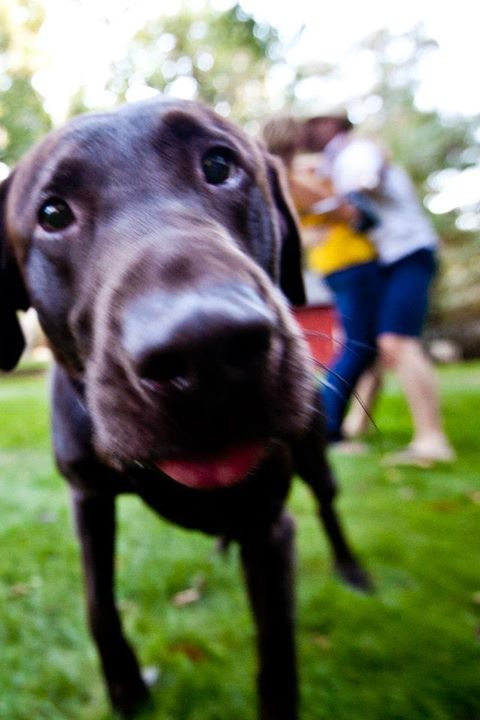
This is Gus:

Image

When I first met Gus I thought he was the most obnoxious beast I’d ever had the misfortune of encountering.  My husband got Gus as a puppy several years prior to our meeting and hadn’t had the heart to discipline him much.  When Cameron first brought Gus home he let the puppy sleep in bed with him curled up on his chest until one night Cameron awoke to Gus happily taking a dump there.

After that Gus was crate trained, but that was pretty much the extent of his training.  By the time I was in the picture Gus was sleeping in the bed again, although he had thankfully learned to poop elsewhere.  I actually had to fight Gus for space on the bed at first.

My general dislike for the mongrel wasn’t changing towards admiration.  Especially since he tended to try to dart out the front door and run away as often as possible, causing me or my husband to chase after him.  He was still intact then and constantly on the prowl for bitches.  Trying to corral his energy to walks proved disastrous.  Gus nearly pulled me down the street.  He also constantly jumped up on me and peed with reckless disregard for furniture and feet alike.  I assumed that Gus was just something I would have to deal with because my husband (then boyfriend) loved him.

Then one day I got a frantic call from Cameron at work.  We were just dating, but I had already moved in.  He was out of town on a training mission.  Our roommate had taken Gus for a walk that morning.  Gus had broken free of his collar and ran straight into the path of a minivan.

Cameron was gone, and I had to do something.  I was 25 and broke, but I didn’t hesitate to put down a $500 deposit so that the vet could get to work. It was tense waiting to hear if he would be alright.

He almost lost a leg.  It still bears the scars and he limps in the cold.  Thankfully, the rest of him was undamaged, and today only the scars give proof that he was ever injured.

Before I took him home that day I bought him a new dog bed and special treats.  It cost me another $100, but I wanted him to be comfortable.  I couldn’t let him up on the people bed where he usually slept, because if he tried to jump down he’d hurt himself even worse.  I got the largest, plushest bed I could find and set it up in the bedroom.

Lying in his new dog bed on the floor next to me, he kept crying in pain, even though I’d given him all of the pain medicine I could.  I got down next to him with a pillow and the comforter and cooed at him while gently stroking his fur to try to calm him down.  It was the hardest night of my life.

That night Gus became my dog too.  He went from an unimaginable annoyance to my baby. There are more pictures of him on my phone now than anything else.  I have many conversations with him, although his English skills are lacking.  It’s ok though; I’ve become a master of interpretation.  A whimper after I’ve stopped scratching his back might translate to: “why did you stop petting me?  Don’t you love me so much that you want to be petting me and playing with me ALL THE TIME?”  And I do love him.  I love this dog so much that I’ll pick up his poop with a plastic bag and let him lick my face even though I know he also loves to lick his butthole.

Gus became even more important to me when we did our first PCS to New England as a family.  I went from working full-time to unemployed.  I volunteered and started hobbies, but found that Gus was my constant companion.  Cameron had to leave for various trips, including an 8-week stint in VA while I mostly stayed in the North East.  Gus made me feel safe, even though he is afraid of almost everything including rain, stairs, small dogs, kitchen gadgets, vacuum cleaners, the ukulele and baths.  His presence was enough to make me feel less lonesome during days at home or when my husband had to leave for extended periods.

Now I know that when Cameron goes on deployment, Gus will be there to dutifully notify me with a howl whenever a leaf passes before a streetlamp at 3 in the morning.  He’s done it before, and while a bit startling, it’s also a comfort I never knew I’d need.  If I lived near family or had a husband whose job didn’t require him to leave for months at a time, it might be different.  But as it stands this goofy pup is the glue that keeps it all working, and I love him for it.


6 Comments

OMG Dramz!

Recently a post came across my facebook newsfeed from a spouse whose post had been DELETED (gasp!) from the officer spouse page.  The nerve.  Apparently she had raised a question regarding military healthcare that was somewhat lacking in tact.  This was seen as an affront to the medical corps and taken down. 

What’s funny to me is that I’ve had countless conversations with spouses and active duty members regarding healthcare, and many are dubious of the quality of care provided at military facilities.  I myself have had scheduling issues, impersonal doctors, and at least one corpsman who seemed to be checking out more than my pulse.  It’s not a novel issue but instead something I’ve heard dozens of times.  That is why the option exists for family members to choose providers off base and accept a copay.

The problem with this post seems to be twofold. It lacked tact, and it was in a public forum.  It’s kind of like how it’s ok for you to make fun of your own little brother in private, but as soon as someone else does it in public, then Heavens to Betsy they had better say their prayers. 

And thus a melodrama unfolded in the 40+ comments made. 

Honestly, I couldn’t care less about the military healthcare debate.  Deciding on a provider is a personal choice and to each their own.  What I find fascinating is the intense drama that frequently arises on spouse pages. 

It’s such a problem that one local page eloquently states at the header: “This is a place to meet new ppl and make new friends. So mind your manners, keep your drama on your own page and remember the golden rule! were all adults here so lets keep it positive and hopefully have some fun!”

You heard it ppl.  Keep your drama on your own page. 

This header aside, I’ve seen more catfights break out between spouses on facebook than I can count.  It seems nearly impossible to make a post that says more than “hello” without hurting someone’s feelings.  But why?

My husband tells me that when he first joined the military he felt an immense sense of belonging.  He was part of something.  With that feeling of belonging he felt acceptance.  The military indeed strives to foster a sense of belonging that I think extends to military families.  What my husband didn’t initially realize was this sense of acceptance didn’t necessarily extend to his personal beliefs and views on decorum.  It is indeed one military, but its members come from different backgrounds with varying political, religious and cultural views. 

We have to remember that while military members and their spouses all identify in the same general group, we’re culturally diverse.  There is no singular correct form of address or even tact, and it’s easy to get hurt feelings.  I am from California.  Much to my mother’s Southern chagrin, I am not overly ladylike.  I burp uncontrollably and have a colorful vocabulary.  While I in no way find this behavior offensive, I can understand that others might.  This is one small example and countless more exist.  Likewise one spouse might think it totally acceptable to outright dis military healthcare, while another might see it as an affront. 

My prescription for this malady of misunderstanding is this: take a chill pill.  Seriously, relax.  Usually people aren’t actively trying to be terrible, and if by some chance they are, it’s no use arguing with them. 

The amount of drama on facebook can honestly be really off-putting.  Especially as a relatively new spouse, I was actually a little afraid of other spouses when I joined my first spouse related facebook group.  The in fighting is unnecessary and unwarranted.  So let’s all try the benefit of the doubt going forward.


6 Comments

Winter

After Zeus overthrew his Titan father, Cronos, he decided to be a good guy and share ruling the world with his two bros, Poseidon and Hades.  Zeus got the sky, Poseidon got the sea and Hades got the shaft, being forced to rule over dead people in the underworld.

Unfortunately being the lord of the dead wasn’t doing much to get Hades laid.  He needed a bride, but couldn’t convince any of those hot Olympian goddesses to get down (way down) with him.  So he decided to kidnap and rape his niece, Persephone, and make her his child bride, because both incest and child rape were totally cool as long as you were a god.

Persephone’s mom, Demeter, was heartbroken.  She didn’t want her flower-child daughter to live below ground with her creepy brother.  So Demeter did the only logical thing, and exercised her power over the harvest to keep crops from growing.  At first this wasn’t so bad for the other gods, but eventually people on earth started dying and then they couldn’t offer up sacrifices.  Now that was too far.  Zeus begged Demeter to turn on the harvest, but she refused unless she got her daughter back.  Very Sally Field of her.  Zeus went down below and forced Hades to give Persephone back.

It should have ended right there.  Unfortunately, Persephone got hungry while she was held captive.  She ate three whole pomegranate seeds to satiate her.  What a glutton.  Eating the food of the dead meant that she would always be forced to return to Hades for three months out of each year, one month per seed.  And each year when Persephone leaves her mother mourns her, and the crops fail and the world gets stuck in winter.

So that was the start of winter: pedophilia and pomegranates.

Growing up primarily in Northern California, the concept of winter seemed about as real as the story above.  Winter meant more rain, greener grass and temperatures in the mid 60’s.  It was the wet season, but never much worse than that.  “Winter” never really set in as something to be reckoned with.

Then I married a military man and moved to New England at the end of one November.  I had no idea that almost everything can freeze before then.  Nor did I actually know that winds really can (and will) chill you to the bone.  I had always used the Twain witticism that the coldest winter he’d ever spent was a summer in San Francisco to show my prowess in colder climates.  I tell you, sir, I’ve spent many summer days in San Francisco, and a winter in New England is vastly worse.

Winter is tough.  I’d always seen snow filled vistas and thought they looked idyllic.  As a small child I spent a few winters in Michigan, but only ever remembered outdoor ice-skating and snowmen.  The cold temperatures never registered in my memory.  All I retained were the fun bits.  Maybe the less fun bits would have stuck if I’d needed to perform winter chores like shoveling the driveway, but that’s not usually the type of thing required of a 6-year-old.

I muddled through my adult life generally believing that winter was some kind of magic for those who actually got snow.  It just meant sledding, skating and snowmen.  Living in the North East has taught me different.  As an adult, winter sucks.  It means layering up and doing chores.  If I never shovel another driveway of snow I may be able to die happy. Most of the time the snow isn’t even good for snowmen and little kids usually hog all of the good sledding hills, depriving me of all the fun stuff I thought might temper the gloom.

Due to some cosmic (or detailing) injustice, my husband and I were sentenced to not one, but two whole winters before our next PCS.  By mid-February both winters I thought that Hell (or Hades) really had frozen over, and taken root in the ice and snow covered oblivion we lived in.

To be fair, I learned a lot too.  My first February a storm took out the power for 30 hours and we didn’t have heat.  It got down to 40 degrees in the house.  I actually brought in my spin bike to do a few minutes on it every half hour to stay warm.  I also lacked almost any foods that could be made outside of a microwave and felt I might starve.  After that I learned preparedness.  I learned to start keeping non-perishable foods and water bottles in the house.  I also kept my next post race “blanket” that is designed to keep heat in after my next race.  I realized that even though other territories are generally warmer, it’s usually good to keep survival items on hand.  An earthquake could have hit me in CA and I would have been screwed.  Now I’m optimistically cautious: I hope for the best, but prepare for the worst in any new environment.  I still despise the snow and cold weather.  That will likely never change, but at least the lesson it taught me was a good one.